

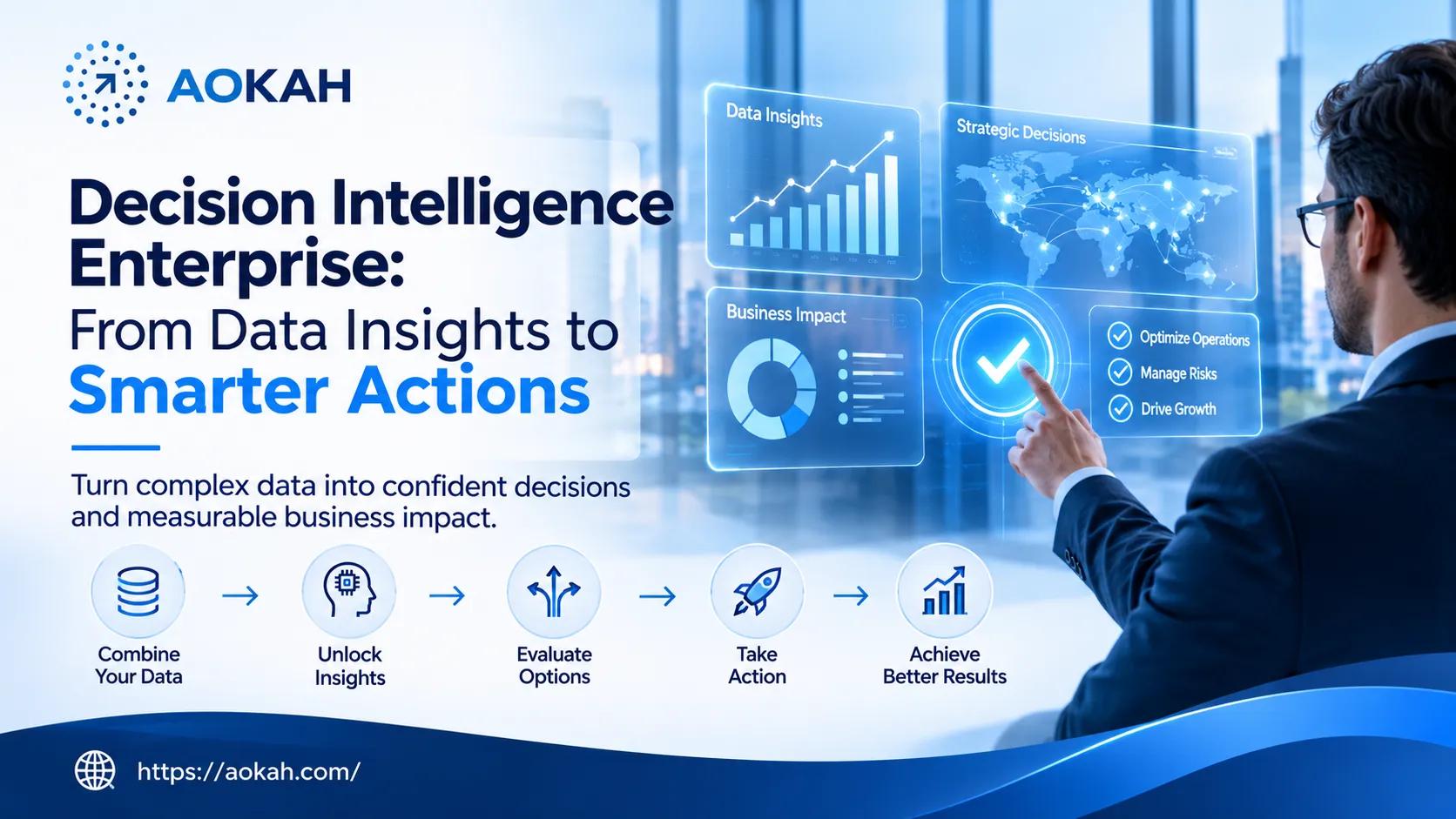
Introduction
Every enterprise generates enormous amounts of data. From financial reports and workforce analytics to customer information and operational dashboards, organizations have access to more insights than ever before. Yet having data does not automatically lead to better decisions.
Many businesses still struggle to turn information into timely, coordinated, and measurable actions. Different departments work with separate systems, reports provide conflicting perspectives, and important decisions often depend on manual analysis. As a result, opportunities can be missed, risks may go unnoticed, and execution can become slower than business demands.
This is where a decision intelligence enterprise approach becomes valuable. It connects data, analytical insights, business context, and operational execution to help organizations make more informed decisions and translate them into meaningful outcomes.
For enterprises managing complex global operations and Global Capability Centers (GCCs), this approach can create greater visibility, improve coordination, and support confident decision-making throughout the business lifecycle.
1. What Is Enterprise Decision Intelligence?
Enterprise decision intelligence is an approach that combines data, analytics, artificial intelligence, business knowledge, and decision-making processes to improve how organizations evaluate choices and take action.
Traditional analytics often focuses on explaining what happened or identifying what may happen next. Decision intelligence goes a step further by helping leaders understand their available options, evaluate possible outcomes, and determine what action best supports their business objectives.
For example, an enterprise planning to establish a new Global Capability Center may need to evaluate several locations. Each option involves different talent availability, operating costs, infrastructure requirements, regulatory considerations, and long-term growth opportunities.
Instead of reviewing these factors separately, a decision intelligence enterprise approach connects them into a structured decision-making process.
This gives business leaders a clearer understanding of the trade-offs involved and helps them move from fragmented information to coordinated action.
2. Why Traditional Business Intelligence Is Not Enough
Business intelligence tools have helped organizations collect, organize, and visualize information. Dashboards, reports, and analytics platforms make it easier to understand business performance.
However, visibility alone does not guarantee effective execution.
Several challenges can limit traditional approaches:
Fragmented Data
Different departments often maintain separate systems and reporting structures. This makes it difficult to develop a consistent view of business performance.
Delayed Decision-Making
When teams depend on manual reporting, multiple approvals, or disconnected analysis, decisions may take longer than expected.
Limited Business Context
A report may identify rising operational costs, but it may not explain the underlying causes or show which corrective action is most appropriate.
Weak Connection Between Decisions and Execution
Even when leaders make informed decisions, translating them into responsibilities, milestones, and measurable outcomes can be challenging.
A decision intelligence enterprise framework addresses these gaps by connecting information with business objectives, decision processes, and execution requirements.
3. How Decision Intelligence Turns Insights into Actions
The real value of decision intelligence lies in connecting the entire decision-making journey.
Step 1: Bring Relevant Data Together
The first step is to create a more connected view of business information. Organizations can bring together relevant data from operational systems, financial platforms, workforce tools, market intelligence, and other sources.
A reliable data foundation helps decision-makers work with consistent and relevant information.
Step 2: Understand Business Context
Data becomes more useful when it is connected to business priorities.
For example, a location with lower operating costs may not necessarily be the best choice for a new GCC if the required skills are difficult to hire or workforce scalability is limited.
Decision intelligence helps organizations evaluate information in relation to strategic objectives, operational requirements, and business constraints.
Step 3: Evaluate Different Scenarios
Enterprises rarely have only one possible path. They need to compare alternatives and understand the potential consequences of each decision.
Scenario analysis can help leaders evaluate different locations, investment options, workforce plans, operating models, and expansion strategies.
Step 4: Identify Risks and Opportunities
Artificial intelligence and predictive analytics can help organizations identify emerging patterns, potential risks, and changing business conditions.
For example, talent availability, hiring demand, attrition trends, and market changes may influence the long-term feasibility of an expansion decision.
Step 5: Translate Decisions into Execution
A decision creates business value only when it leads to action.
Organizations need clear ownership, timelines, governance structures, performance indicators, and ongoing monitoring. Connecting these elements helps ensure that decisions remain aligned with business objectives during execution.
4. Key Benefits of a Decision Intelligence Enterprise
Adopting a decision intelligence enterprise approach can support several important business outcomes.
Better strategic alignment: Leaders can evaluate decisions against organizational priorities rather than relying on isolated departmental objectives.
Improved operational visibility: Connected information provides a clearer view of business performance, dependencies, and potential challenges.
More informed risk management: Organizations can identify emerging risks earlier and evaluate possible responses.
Faster decision-making: Structured analysis and connected intelligence can reduce unnecessary manual work and help teams evaluate alternatives more efficiently.
Stronger resource allocation: Enterprises can compare investment requirements, workforce needs, and expected business outcomes before committing resources.
Continuous improvement: Monitoring results and comparing them with expected outcomes helps organizations refine future decisions.
These benefits depend on the quality of the underlying data, the relevance of the analysis, and the organization's ability to act on the insights.
5. Decision Intelligence in Global Capability Center Management
Global Capability Centers operate across multiple business dimensions, including location strategy, talent acquisition, infrastructure, governance, compliance, and service delivery.
As GCCs expand, these areas become increasingly interconnected. A change in talent availability can affect hiring plans. A regulatory development may influence location decisions. Delays in infrastructure readiness can affect launch timelines and operating costs.
A decision intelligence enterprise approach helps GCC leaders evaluate these dependencies together.
For example, before expanding into a new city, decision-makers can assess:
Availability of required skills and workforce depth.
Compensation trends and hiring competition.
Infrastructure and ecosystem readiness.
Regulatory and operational considerations.
Workforce stability and attrition indicators.
Long-term scalability and expansion potential.
This creates a more comprehensive foundation for location selection and investment decisions.
Decision intelligence can also support ongoing GCC management by connecting program performance, execution milestones, operational risks, and optimization opportunities.
Instead of treating GCC setup as a one-time project, enterprises can use connected intelligence to support the complete lifecycle, from planning and launch to governance, expansion, and continuous improvement.
6. How Aokah INC Supports Smarter Enterprise Decisions
Aokah INC helps enterprises build, set up, scale, and optimize Global Capability Centers through an Expert + AI-powered Execution Intelligence Platform.
Its approach combines decision intelligence, adaptive orchestration, real-time insights, and expert oversight to help organizations manage the complexity of global capability execution.
Through its platform capabilities, Aokah INC supports important decision areas across the GCC lifecycle:
Location Intelligence: Helps enterprises evaluate potential locations using relevant factors such as talent availability, operating costs, market conditions, and risk.
Talent Intelligence: Provides insights into workforce availability, hiring velocity, skill depth, emerging capabilities, and attrition indicators.
Scenario and Business Case Evaluation: Supports the comparison of alternatives and helps leaders assess the business case before making significant commitments.
Execution Intelligence: Helps connect planning with program milestones, dependencies, governance, and risk monitoring.
Continuous Optimization: Supports ongoing evaluation of operational performance and opportunities to improve efficiency, resilience, and scalability.
By bringing these capabilities together, Aokah INC helps organizations move beyond disconnected reports and isolated decisions toward a more coordinated approach to global capability execution.
Conclusion
In a business environment where complexity and change are constant, collecting more data is not enough. Enterprises need a structured way to understand information, evaluate alternatives, manage risks, and turn decisions into measurable actions.
A decision intelligence enterprise approach creates this connection between insight and execution. It helps leaders make informed choices, align teams around business objectives, and respond more effectively to changing conditions.
For organizations building and expanding Global Capability Centers, this approach can be particularly valuable because location, talent, cost, governance, and execution decisions are closely connected.
With its Expert + AI-powered execution intelligence approach, Aokah INC helps enterprises bring greater clarity, coordination, and confidence to their GCC decisions.
Move beyond data insights. Make smarter decisions and turn them into meaningful business action with Aokah INC.
Frequently Asked Questions (FAQs)
1. What is a decision intelligence enterprise?
A decision intelligence enterprise uses data, analytics, artificial intelligence, business context, and structured decision processes to help organizations make informed choices and translate insights into actions.
2. How is decision intelligence different from business intelligence?
Business intelligence primarily focuses on organizing, analyzing, and presenting business data. Decision intelligence goes further by helping organizations evaluate alternatives, understand potential outcomes, and connect decisions with execution.
3. Why is decision intelligence important for modern enterprises?
It helps enterprises address fragmented information, improve strategic alignment, evaluate risks, compare business scenarios, and make decisions that support measurable business objectives.